
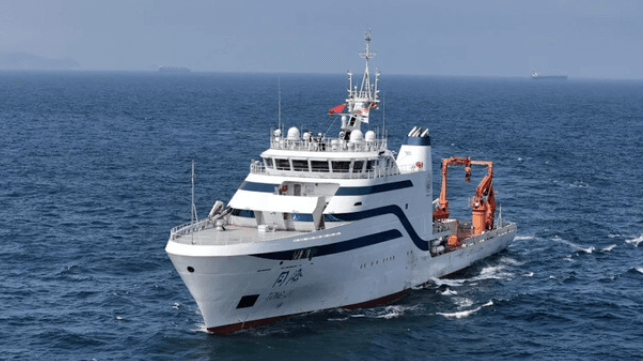
China recently marked a milestone in maritime science with the official delivery of its first intelligent deep‑sea research vessel, the Tongji, built at the Huangpu Wenchong shipyard in Guangzhou.
This 81.5‑meter vessel, weighing 2,000 tons with a crew complement capacity for 45 people (including 30 scientists), completed its sea trials in May and is set to launch its maiden research expedition in the South China Sea this August.
⚙️ Intelligent Features & Capabilities
Diesel‑electric propulsion system: domestically produced, enabling speeds up to 15 knots .
Autonomous open‑water navigation: employs advanced AI-driven route planning for energy-efficient operations and remote-control capability from shore .
Power management system: dynamically distributes power to optimize fuel use and onboard systems .
Flexible research labs: modular 320 m² lab space allows for scientific work in oceanography, marine biology, geology, and engineering; supports tasks from cable laying to seabed mapping .
🌐 Strategic Context
Operated by Tongji University, the Tongji is part of China’s expanding fleet of civilian research ships. Though rooted in scientific objectives, these vessels increasingly navigate contested waters—including the Western Pacific and Indian Ocean—triggering questions about potential dual civilian–military use . Its debut reflects China’s dual priorities: advancing maritime science and projecting oceanographic presence.
📅 Upcoming Missions
The Tongji’s maiden voyage is slated for August in the South China Sea, focusing on multidisciplinary research and testing its autonomous systems in real-world conditions .
🔍 Interesting Fact
China Classification Society’s designation of the Tongji as an ‘Intelligent-ship (I‑ship)’ underscores its embrace of AI, autonomous navigation, and smart energy systems—a noteworthy move for a nation that prioritizes marine technology innovation at the highest levels .